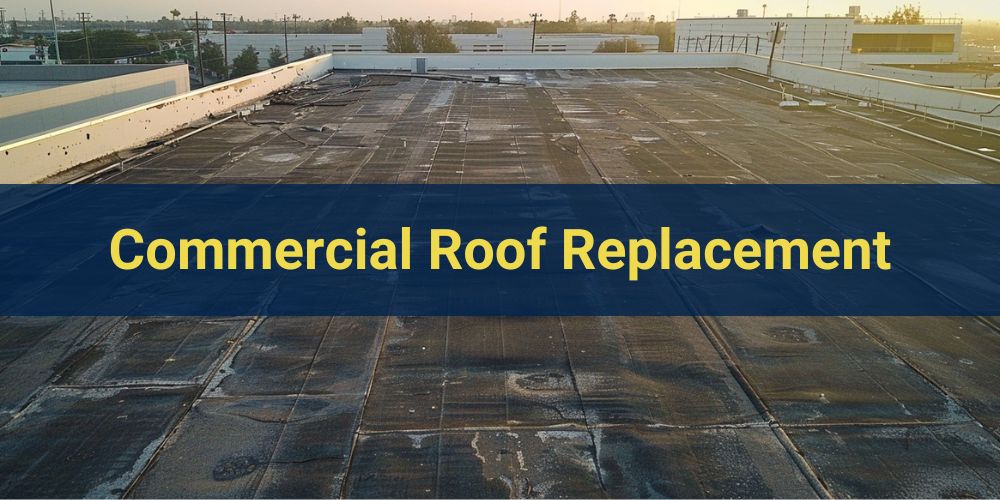
Commercial Roofing Doral provides commercial roof replacement services across Doral, Florida, for flat and low-slope commercial buildings where the existing roof can no longer be reliably repaired, coated, restored, or partially replaced. Commercial roof replacement is used when the roof assembly has reached a condition where long-term waterproofing, attachment stability, drainage performance, storm resistance, or substrate reliability cannot be restored through targeted correction alone. Commercial roof replacement is not the same as roof repair, roof maintenance, roof inspection, or commercial roof coating. Replacement is a full roof renewal process used when the existing roof has moved beyond serviceable condition because deterioration is distributed across the membrane, panels, seams, flashings, drains, insulation, substrate, attachment system, coating layers, or roof perimeter. Commercial Roofing Doral recommends replacement only where continued repair or restoration would delay necessary renewal rather than protect the building. In Doral, commercial roof replacement decisions must account for frequent heavy rainfall, high humidity, intense sun exposure, hurricane-season wind pressure, rooftop HVAC activity, airborne debris, low-slope drainage sensitivity, and possible grease, oil, exhaust, or chemical exposure from restaurants, warehouses, logistics facilities, and industrial properties. These conditions can accelerate seam failure, membrane ageing, coating breakdown, roof-edge movement, drainage deterioration, concealed moisture spread, corrosion, and storm-related roof damage. Commercial Roofing Doral evaluates replacement needs by reviewing roof system type, leak distribution, moisture saturation, membrane or panel condition, seam and flashing performance, drainage behaviour, storm damage, wind-uplift vulnerability, substrate stability, insulation condition, attachment integrity, rooftop equipment impact, contamination exposure, prior repair history, coating viability, and remaining service life. This determines whether the correct scope is targeted repair, broader restoration, partial replacement, or full commercial roof replacement.
Commercial roof replacement in Doral is appropriate when the existing roof assembly has moved beyond dependable service and a new commercial roof system is required to restore long-term building protection.
- System-wide roof failure → repeated leaks, widespread membrane damage, broad seam failure, multiple flashing defects, deteriorated panels, coating collapse, unstable attachment, or multi-zone deterioration affects the roof as a connected assembly → repair no longer restores dependable performance → replacement renews the failed roof system → long-term waterproofing reliability is restored.
- Moisture saturation and concealed deterioration → water has spread into insulation, cover boards, substrate layers, or concealed roof areas → surface repair or coating would trap moisture inside the assembly → replacement removes wet or compromised materials where required → hidden deterioration, recurring leaks, and interior damage are controlled.
- Storm, wind-uplift, or perimeter failure → hurricane-season wind pressure, uplift movement, displaced edge metal, loosened membranes, damaged panels, failed fasteners, or opened terminations has compromised roof stability → local repair cannot restore system-wide wind resistance where damage is distributed → replacement rebuilds secure roof edges, attachment, and weatherproofing details → storm-related water entry risk is reduced.
- Drainage-related assembly damage → blocked drains, restricted scuppers, clogged gutters, low points, ponding areas, or repeated heavy rainfall have caused seam fatigue, coating failure, wet insulation, substrate damage, or recurring water entry → isolated repair cannot correct a water-damaged roof assembly → replacement allows damaged materials and drainage details to be corrected together → future rainfall-driven deterioration is reduced.
- End-of-life roof condition → age, repeated repairs, declining material performance, widespread deterioration, surface brittleness, corrosion, failed coatings, unstable substrate, or loss of serviceability shows that the roof can no longer protect the building reliably → replacement becomes the correct long-term intervention → the property receives a new commercial roof assembly matched to building use, exposure, and performance requirements.
Commercial Roofing Doral performs commercial roof replacement as a condition-based renewal decision, not as the default answer to every roof problem. By confirming when repair, coating, restoration, or partial replacement is no longer dependable, Commercial Roofing Doral replaces commercial roofs only where a new roof assembly is required to restore waterproofing performance, storm resilience, drainage control, and long-term asset protection.
When Does a Commercial Roof Need Replacement in Doral?
A commercial roof needs replacement in Doral when the existing roof assembly can no longer provide dependable waterproofing, drainage performance, attachment stability, storm resistance, or substrate support through repair, coating, restoration, or partial replacement. Replacement is required when roof failure is distributed across the system rather than limited to one isolated leak, seam defect, flashing issue, puncture, coating failure, or drainage problem. Commercial Roofing Doral separates replacement conditions from repairable roof defects by evaluating roof system type, leak distribution, moisture saturation, membrane or panel condition, seam and flashing performance, drainage behaviour, storm exposure, wind-uplift damage, substrate condition, insulation performance, attachment integrity, rooftop equipment impact, contamination exposure, prior repair history, coating viability, and remaining service life. This ensures replacement is recommended only when the existing roof has moved beyond a dependable service range.
Commercial roof replacement is required under the following conditions:
- Repeated leaks across multiple roof zones → water entry appears at seams, flashings, penetrations, drains, roof edges, coating defects, membrane areas, panels, fasteners, or rooftop equipment zones in different sections of the roof → the roof is failing as a connected assembly rather than through one local defect → continued patching creates short repair cycles without restoring reliability → replacement restores continuous building protection.
- Moisture saturation beneath the roof surface → water has migrated into insulation, cover boards, substrate layers, or concealed roof areas → surface repair or coating would trap moisture inside the assembly → wet or compromised materials must be removed or addressed as part of a wider scope → replacement prevents concealed deterioration, recurring leaks, and ongoing interior damage.
- Storm or wind-uplift damage is no longer localised → hurricane-season wind pressure, uplift movement, displaced edge metal, damaged membranes, shifted panels, failed fasteners, opened terminations, or torn details affect multiple roof areas → local repair cannot restore reliable wind resistance across the system → replacement rebuilds attachment, perimeter securement, and weatherproofing continuity → future storm-driven water entry risk is reduced.
- Drainage failure has damaged the roof assembly → heavy rainfall, blocked drains, restricted scuppers, clogged gutters, low points, or ponding areas have caused seam fatigue, coating failure, wet insulation, substrate deterioration, or recurring water entry → repair will not hold if the roof base has already been compromised → replacement allows damaged materials and drainage details to be corrected together → rainfall-driven deterioration is reduced.
- The substrate or attachment system is unstable → soft decking, unstable cover boards, failed fasteners, loose panels, membrane movement, weakened attachment, deteriorated layers, or structural support concerns prevent reliable roof performance → repair or coating cannot create a stable roof base → replacement corrects the failed assembly at the proper scope → premature failure of future roof work is avoided.
- Membrane, panel, or coating deterioration is widespread → TPO, PVC, EPDM, modified bitumen, metal, foam, built-up roofing, or coated roof areas show broad cracking, brittleness, corrosion, punctures, seam weakness, coating collapse, surface erosion, shrinkage, blistering, or material fatigue → the roof no longer has enough serviceable material for dependable local correction → replacement renews the roof system → long-term waterproofing reliability is restored.
- Commercial contamination has compromised roof performance → grease discharge, exhaust residue, oil contamination, cleaning chemicals, industrial runoff, condensate discharge, or rooftop service exposure has damaged membranes, coatings, seams, repairs, or roof surfaces beyond local correction → cleaning and patching cannot restore reliable performance where exposure damage is distributed → replacement renews the affected roof assembly → contamination-related roof failure is controlled.
- Repair, coating, or restoration is no longer dependable → prior repairs are failing, coating is no longer viable, leak recurrence continues, storm damage has spread, moisture is present beneath the surface, or the roof has lost serviceable condition → continued correction would delay necessary renewal rather than protect the building → partial or full commercial roof replacement becomes the correct intervention → long-term asset protection is restored.
- The roof has reached end-of-life condition → age, repeated leaks, widespread deterioration, severe coating failure, membrane brittleness, corrosion, unstable substrate, multi-zone moisture, failed attachment, or declining material performance shows that the roof can no longer function reliably → replacement is required to restore a dependable commercial roof assembly → the building receives a roof system matched to current exposure, drainage, use, and performance requirements.
Commercial Roofing Doral recommends commercial roof replacement only when the roof has moved beyond dependable repair, coating, restoration, or partial correction. Where defects remain localised, targeted repair or restoration may still be appropriate. Where leaks, moisture, storm damage, drainage failure, substrate instability, material deterioration, or end-of-life conditions are distributed across the roof assembly, replacement becomes the correct long-term path.
Have a question about an upcoming commercial roofing project?
How Does Commercial Roofing Doral Complete Commercial Roof Replacement?
Commercial Roofing Doral completes commercial roof replacement by confirming that the existing roof is no longer dependable, defining the correct replacement scope, removing or correcting failed roof assembly conditions, preparing a stable base, installing the selected commercial roof system, and verifying that the completed roof restores long-term waterproofing performance. Commercial roof replacement must be managed as full roof renewal, not as an enlarged repair, because the work must address the conditions that made the existing roof unreliable. In Doral, commercial roof replacement must account for frequent heavy rainfall, high humidity, intense sun exposure, hurricane-season wind pressure, rooftop HVAC activity, airborne debris, low-slope drainage sensitivity, and possible grease, oil, exhaust, or chemical exposure from commercial operations. These conditions affect roof system selection, attachment method, drainage design, perimeter securement, flashing detail, rooftop equipment integration, coating compatibility, and long-term service performance.
Commercial roof replacement by Commercial Roofing Doral includes:
- Replacement scope confirmation → roof system type, leak distribution, moisture saturation, membrane or panel condition, seam failure, flashing performance, storm damage, drainage behaviour, substrate stability, attachment integrity, rooftop equipment impact, contamination exposure, and remaining service life are reviewed before replacement begins → the roof is confirmed as partial-replacement or full-replacement suitable → the replacement scope matches the actual failure pattern → under-scoped renewal and unnecessary full replacement are avoided.
- Existing roof assembly evaluation → the failed roof is reviewed as a connected assembly rather than a surface layer alone → membranes, panels, insulation, cover boards, fasteners, adhesives, coatings, flashings, drains, roof edges, penetrations, and substrate conditions are evaluated → compromised components are identified before installation planning → the new roof is not installed over conditions that would shorten service life.
- Moisture-damaged material removal or correction → wet insulation, saturated cover boards, soft substrate, blistered areas, concealed moisture zones, and deteriorated layers are addressed during replacement → compromised materials are removed, isolated, corrected, or rebuilt as required → the new commercial roof system is installed over a dry and serviceable base → trapped moisture, recurring leaks, and hidden deterioration are prevented.
- Substrate and attachment preparation → decking, cover boards, insulation layers, fastener pull-out areas, adhered-system surfaces, metal panels, edge securement, and support conditions are prepared for the new roof assembly → unstable or weakened areas are corrected before installation proceeds → the replacement roof receives a dependable base and attachment path → premature movement, uplift vulnerability, and installation failure risk are reduced.
- Drainage and low-slope roof correction → drains, scuppers, gutters, outlets, valleys, ponding areas, slope conditions, low points, and water-retaining zones are reviewed during replacement planning → drainage defects that contributed to roof failure are corrected where scope allows → the new roof is not exposed to the same unmanaged water pressure → rainfall-driven deterioration and recurring ponding damage are reduced.
- Storm, wind-uplift, and perimeter detailing → roof edges, corners, parapets, terminations, edge metal, fasteners, plates, adhesives, flashings, and attachment zones are detailed with Doral wind exposure in mind → perimeter and uplift-prone areas receive proper securement and integration → the replacement roof is built to resist wind movement and storm-driven water entry more reliably → edge failure and perimeter leak risk are reduced.
- Commercial roof system selection → TPO, PVC, EPDM, modified bitumen, metal, foam, built-up roofing, coated restoration, or another suitable commercial roof system is selected according to building use, roof slope, drainage profile, exposure conditions, chemical or grease risk, rooftop equipment layout, energy goals, and long-term maintenance expectations → the selected system matches the property’s performance requirements → material mismatch and premature replacement failure are avoided.
- Flashing, penetration, and rooftop equipment integration → HVAC curbs, exhaust units, vents, pipes, drains, roof hatches, skylights, parapets, service lines, condensate areas, equipment supports, and roof transitions are rebuilt or integrated into the new roof system → high-risk details receive system-compatible waterproofing treatment → leak-prone junctions are renewed rather than patched around → recurring equipment-zone and penetration leaks are reduced.
- Contamination and exposure-zone planning → restaurant exhaust, grease discharge, oil exposure, industrial residue, cleaning chemicals, condensate runoff, and rooftop service areas are reviewed where relevant → the replacement system, detail protection, walkway strategy, or surface protection is matched to actual exposure → contamination-prone areas are not treated like ordinary roof field areas → exposure-related deterioration and repair cycles are controlled.
- Final replacement verification → completed roof field areas, seams, flashings, penetrations, drains, scuppers, gutters, roof edges, attachment points, rooftop equipment zones, drainage paths, and transition details are reviewed before closeout → incomplete details, exposed vulnerable areas, drainage concerns, weak terminations, or installation issues are identified → the replacement roof is returned to service as a verified commercial roof assembly → early leaks and premature performance issues are reduced.
Commercial Roofing Doral completes commercial roof replacement by correcting the failed roof assembly and installing a new system matched to the building’s exposure, drainage behaviour, roof use, and long-term performance needs. By confirming replacement scope, addressing moisture and substrate conditions, correcting drainage issues, managing storm and perimeter detailing, integrating rooftop equipment, and selecting the correct commercial roof system, replacement restores dependable roof performance for Doral commercial properties where repair or restoration is no longer reliable.
Have a question about an upcoming commercial roofing project?
What Commercial Roof Systems Can Replace an Existing Roof in Doral?
An existing commercial roof in Doral can be replaced with a roof system selected according to the building use, roof slope, drainage behaviour, storm exposure, rooftop equipment layout, substrate condition, chemical or grease exposure, energy goals, and long-term maintenance requirements. Commercial Roofing Doral does not treat commercial roof replacement as a one-system decision. The replacement system must match the reason the existing roof failed and the conditions the new roof will face after installation. In Doral, replacement system selection must account for frequent heavy rainfall, high humidity, intense sun exposure, hurricane-season wind pressure, low-slope drainage sensitivity, rooftop HVAC activity, airborne debris, and possible grease, oil, exhaust, or chemical exposure from restaurants, warehouses, logistics facilities, and industrial properties. These conditions affect membrane choice, attachment method, seam strategy, flashing design, drainage planning, coating compatibility, perimeter detailing, and expected service life.
Commercial roof systems that can replace an existing roof in Doral include:
- TPO roof replacement → TPO is used where a flat or low-slope commercial building needs single-ply waterproofing, heat-welded seams, UV resistance, and broad roof-area coverage → the system is suitable for many warehouses, retail properties, office buildings, and multi-tenant commercial roofs → seam quality, attachment method, drainage behaviour, and rooftop equipment detailing must be controlled → the replacement roof gains a modern single-ply waterproofing assembly.
- PVC roof replacement → PVC is used where a commercial roof needs single-ply waterproofing, heat-welded seam performance, chemical resistance, grease exposure tolerance, or stronger compatibility with restaurant, food-service, industrial, or exhaust-heavy roof conditions → chemical exposure areas, drains, seams, flashings, and rooftop equipment zones are reviewed before selection → the replacement system is matched to both water exposure and operational exposure → material mismatch risk is reduced.
- EPDM roof replacement → EPDM may be selected where a commercial property needs a flexible single-ply membrane with suitable movement performance for the building and roof design → seams, adhesive performance, flashing transitions, drainage conditions, and rooftop traffic must be evaluated carefully under Doral heat and rainfall exposure → the system is selected only where its performance profile matches the building conditions → long-term waterproofing reliability depends on correct detailing and maintenance.
- Modified bitumen roof replacement → modified bitumen may be used where a low-slope roof needs a durable multi-layer asphalt-based system with strong puncture resistance and detail adaptability → it can suit commercial buildings with service traffic, equipment zones, or roof areas requiring reinforced waterproofing → drainage, heat exposure, flashing integration, and substrate preparation must be addressed during replacement → the roof gains a robust membrane assembly where this system fits the property.
- Metal roof replacement → metal roof replacement is used where the building requires a panel-based roof assembly with long-term durability, structural performance, and serviceable roof areas → attachment, panel condition, seams, laps, fasteners, corrosion resistance, roof slope, drainage paths, and wind-uplift detailing must be matched to the building → the replacement roof must control fastener, panel, flashing, and perimeter vulnerabilities → long-term performance depends on correct panel and detail execution.
- Built-up roofing replacement → built-up roofing may be selected where a commercial building benefits from a layered roof assembly with redundant waterproofing protection → roof load, substrate condition, drainage behaviour, flashing requirements, rooftop equipment density, and maintenance expectations must be evaluated before selection → the system can provide multi-layer protection where appropriate → replacement suitability depends on the building’s structure and performance requirements.
- Foam roofing or SPF replacement where suitable → spray polyurethane foam may be considered where a viable roof design requires seamless insulation, surface contouring, and continuous coverage under a protective coating system → the substrate must be dry, stable, compatible, and suitable for foam adhesion → drainage behaviour, coating protection, rooftop equipment zones, and maintenance requirements must be reviewed before selection → foam replacement is appropriate only where the roof can support a protected SPF system.
- Roof coating or restoration as an alternative to replacement → silicone, acrylic, elastomeric, reflective, urethane, or another compatible coating system may be considered only when the existing roof remains dry, stable, repairable, and coating-suitable → coating is not a replacement for a saturated, unstable, storm-damaged, or end-of-life roof assembly → restoration may defer replacement where the roof is still viable → full replacement is recommended where coating would only cover unresolved failure.
Commercial Roofing Doral selects the replacement system by matching the roof type to Doral’s rainfall, humidity, UV exposure, wind-uplift pressure, drainage behaviour, rooftop equipment activity, contamination risk, and building-use requirements. TPO, PVC, EPDM, modified bitumen, metal, built-up roofing, foam roofing, or coating-based restoration may each be appropriate under different roof conditions. The correct choice is the system that solves the failure pattern of the existing roof while supporting long-term waterproofing, attachment stability, drainage performance, and building protection.
Have a question about an upcoming commercial roofing project?
Why Choose Commercial Roofing Doral for Commercial Roof Replacement?
Commercial Roofing Doral is chosen for commercial roof replacement because replacement should only be recommended when the existing roof has moved beyond dependable repair, coating, restoration, or partial correction. A commercial roof replacement decision must confirm that the failure is no longer isolated, that the surrounding roof assembly cannot reliably support targeted work, and that a new roof system is the correct long-term path for building protection. In Doral, replacement judgement must account for frequent heavy rainfall, high humidity, intense sun exposure, hurricane-season wind pressure, low-slope drainage sensitivity, rooftop HVAC activity, airborne debris, and possible grease, oil, exhaust, or chemical exposure from commercial operations. Commercial Roofing Doral evaluates these conditions when reviewing moisture saturation, substrate stability, drainage behaviour, storm or wind-uplift damage, perimeter securement, attachment integrity, rooftop equipment impact, prior repair failure, and remaining service life. Commercial Roofing Doral is selected because roof replacement is treated as a full assembly decision, not a surface-level material swap. The replacement scope is based on roof system type, leak distribution, wet insulation risk, cover board condition, deck or substrate viability, flashing performance, drainage defects, wind-uplift exposure, contamination risk, equipment-zone detailing, and the performance requirements of the building. This prevents a new roof from being installed over unresolved moisture, unstable substrate, poor drainage, weak perimeter details, or incompatible exposure conditions. Commercial Roofing Doral also matches the replacement system to the property rather than forcing one roof type onto every building. TPO, PVC, EPDM, modified bitumen, metal, built-up roofing, foam roofing, or coating-based restoration may each be appropriate under different conditions. The correct system is selected according to roof slope, building use, rainfall exposure, wind-resistance requirements, rooftop equipment layout, chemical or grease exposure, energy goals, maintenance expectations, and long-term asset value. By combining replacement-boundary discipline, moisture and substrate evaluation, Doral storm and drainage awareness, system-specific roof selection, and long-term asset protection, Commercial Roofing Doral helps commercial properties replace failed roof assemblies at the correct scope and avoid both repeated short-term repairs and unnecessary full roof replacement where a lesser intervention would still perform.
When Should a Doral Property Request Commercial Roof Replacement?
A Doral commercial property should request commercial roof replacement when the existing roof has moved beyond dependable repair, coating, restoration, or partial correction. Replacement should be considered when leaks are repeated across multiple roof zones, moisture has spread beneath the roof surface, storm or wind-uplift damage is distributed, drainage failure has damaged the assembly, or the roof has reached an end-of-life condition that can no longer protect the building reliably. In Doral, replacement should be evaluated early when frequent heavy rainfall, high humidity, intense sun exposure, hurricane-season wind pressure, rooftop HVAC activity, low-slope drainage sensitivity, airborne debris, or grease, oil, exhaust, and chemical exposure have accelerated roof deterioration. These conditions can turn repeated repair needs into wider assembly failure when seams, flashings, penetrations, drains, coatings, membranes, panels, insulation, substrate layers, and roof edges are no longer performing together.
Commercial Roofing Doral should be contacted for replacement evaluation when a commercial roof has widespread leaks, recurring interior water damage, wet insulation indicators, unstable substrate, broad membrane deterioration, severe coating failure, repeated flashing defects, failed prior repairs, storm-damaged edges, uplift movement, drainage-related saturation, corrosion, or roof conditions that are affecting tenant operations, inventory, equipment, or building use. These symptoms should be assessed before emergency failure forces rushed replacement decisions. Commercial Roofing Doral evaluates commercial roof replacement requests by reviewing roof system type, leak distribution, moisture saturation, substrate stability, insulation condition, seam and flashing performance, drainage behaviour, storm exposure, attachment integrity, rooftop equipment impact, contamination exposure, prior repair history, coating viability, and remaining service life. This determines whether the correct next step is broader restoration, partial replacement, or full commercial roof replacement. If your Doral commercial property has repeated leaks, moisture spread, storm damage, uplift movement, drainage failure, saturated insulation, unstable substrate, severe coating breakdown, widespread membrane or panel deterioration, recurring failed repairs, corrosion, chemical exposure damage, or uncertainty about whether the roof can still be repaired or restored, request a commercial roof replacement evaluation from Commercial Roofing Doral to define the correct renewal scope and restore long-term building protection.